
An RV accident lawyer specializes in helping victims of recreational vehicle crashes navigate complex liability issues, insurance disputes, and multi-party claims to secure maximum compensation for injuries, medical expenses, lost wages, and pain and suffering.
Quick Answer: What Does an RV Accident Lawyer Do to Help?
- Identifies all liable parties (driver, owner, rental company, manufacturer)
- Investigates the crash and gathers critical evidence
- Handles negotiations with insurance companies
- Calculates full damages including future medical costs
- Files lawsuits before the statute of limitations expires
- Represents you in court if a fair settlement isn’t reached
Recreational vehicles promise adventure, but their convenience comes at a risk to others. Their size and weight create greater opportunities for catastrophic accidents and injuries, especially with untrained drivers. RVs can weigh up to 80,000 pounds compared to the average car that weighs between 2,000 and 4,000 pounds, and accidents involving RV’s result in approximately 75,000 hospitalizations each year.
When a crash occurs, victims face a maze of challenges: multiple at-fault parties, aggressive insurance adjusters, varying state laws, and potential manufacturing defects. This guide explains how an experienced RV accident lawyer cuts through these complexities to fight for the compensation you deserve.
Understanding the Unique Dangers of RV Accidents
RVs aren’t just bigger cars; they are fundamentally different machines that handle nothing like a family sedan. When things go wrong in a vehicle of this size and weight, they go really wrong.
What is a Recreational Vehicle (RV)?
A recreational vehicle is any motorized or towable vehicle designed for temporary living quarters. The term covers a wide range, from bus-like Class A motorhomes and compact camper vans (Class B) to towable travel trailers and fifth-wheels. Each type presents unique handling challenges. For a detailed breakdown, you can review this comprehensive guide to different types of RVs. Understanding the specific vehicle involved is a key step for an RV accident lawyer investigating a crash.
Common Causes of RV Collisions
In most states, a standard driver’s license is all that’s needed to operate a 30,000-pound motorhome, making driver inexperience a leading cause of accidents. Other common factors include:
- Visibility and Blind Spots: RVs have massive blind spots that can easily hide other vehicles, making lane changes and turns hazardous.
- High Center of Gravity: This makes RVs prone to rollovers, especially when turning too quickly or in high winds.
- Driver Error: Speeding and fatigue are especially dangerous in RVs, which require much longer stopping distances. Unlike commercial drivers, RVers are not bound by mandatory rest periods under Federal Motor Carrier Safety Administration regulations.
- Improper Loading: Overloading or poor weight distribution can cause dangerous trailer sway, a fishtailing motion that is difficult to control.
- Mechanical Failure: Tire blowouts and brake failure are common due to the immense weight RVs carry, often exacerbated by poor maintenance.
- Manufacturing Defects: Sometimes, the fault lies with the vehicle itself, such as defective brakes or steering components. Victims may have legal recourse for defective recreational vehicles.
Severe Injuries and Accident Statistics
RV accidents are rarely minor. Annually, they result in approximately 75,000 hospitalizations and an average of 26 fatalities. The sheer size and weight of these vehicles lead to devastating injuries, including:
- Head injuries, such as traumatic brain injuries (TBIs) with lifelong consequences.
- Spinal cord damage, potentially causing partial or complete paralysis.
- Broken bones, often multiple fractures requiring extensive surgery.
- Burns from fires or explosions involving propane tanks and fuel systems.
- Wrongful death, leaving families with unimaginable grief and complex legal challenges.
The physical, emotional, and financial toll is immense. An experienced RV accident lawyer understands the full scope of these injuries and fights for the compensation needed for the long road to recovery. For more insights, explore our resources on recreational vehicle accidents.
The Complexities of an RV Accident Claim
Unlike a typical car crash, an RV accident claim involves a web of potential defendants, conflicting insurance policies, and varying state regulations. This complexity makes it difficult for victims to steer alone, especially while recovering from serious injuries.
Determining Liability: Who Is at Fault?
In an RV crash, multiple parties may share responsibility. An RV accident lawyer investigates to identify every liable party, which could include:
- The RV driver: For errors like speeding, distraction, or inexperience.
- The RV owner: If they allowed an unqualified person to drive or failed to maintain the vehicle.
- Rental companies: For renting out an unsafe vehicle or having confusing liability clauses in their agreements.
- Manufacturers and dealers: If a design or manufacturing defect caused the accident. We have experience pursuing legal recourse for defective recreational vehicles.
- Maintenance shops: If negligent repairs led to mechanical failure.
- Other motorists: Whose actions may have triggered the accident.
Under Maine’s negligence laws, we work to prove that each responsible party breached a duty of care, directly causing your injuries. This process often requires more investigation than what is covered in Federal Motor Carrier Safety Administration regulations.
Navigating Insurance and Liability Differences
RV insurance is a hybrid of auto and home policies, and coverage varies dramatically depending on whether the vehicle is privately owned, rented, or used commercially.
| Feature | Privately Owned RVs | Rented RVs | Commercially Used RVs |
|---|---|---|---|
| Primary Coverage | Specialized RV insurance (hybrid auto/home) | Rental company’s insurance, limited personal auto policy | Commercial vehicle insurance |
| Personal Belongings | May require separate coverage or rider | Often not covered; check homeowner’s policy | Typically covered by commercial policy |
| Liability Coverage | Varies widely by policy | Supplemental Liability Insurance (SLI) often recommended | Mandatory high limits for business operations |
| Key Challenge | Ensuring adequate coverage for vehicle and contents | Understanding rental agreement exclusions; “patchwork” coverage | Strict regulatory compliance; high stakes if gaps exist |
Common gaps include insufficient uninsured/underinsured motorist (UIM) coverage and lack of property damage coverage for items inside the RV. Insurance adjusters are trained to exploit these gaps and fine print to minimize payouts. An RV accident lawyer protects you by identifying all available coverage and fighting for what you are rightfully owed.
State-Specific Regulations and Licensing
RV laws are not consistent across state lines. Here in Maine, you don’t need a commercial driver’s license (CDL) to operate most RVs for personal use, regardless of their size. This means a driver with a standard license can legally operate a massive motorhome with no special training.
Seat belt regulations are also confusing. While front seats have standard belts, many states do not require them in the living or sleeping areas of an RV, as noted by sources like KSNV NBC Las Vegas on seat belt regulations. This lack of consistent regulation contributes to the unique dangers of RV travel. Our team understands these legal nuances and how they affect your case.
Steps to Take Immediately After an RV Accident
The moments after an RV accident are chaotic, but the actions you take can significantly impact your health and your legal claim. Here’s a step-by-step guide to help you protect yourself.
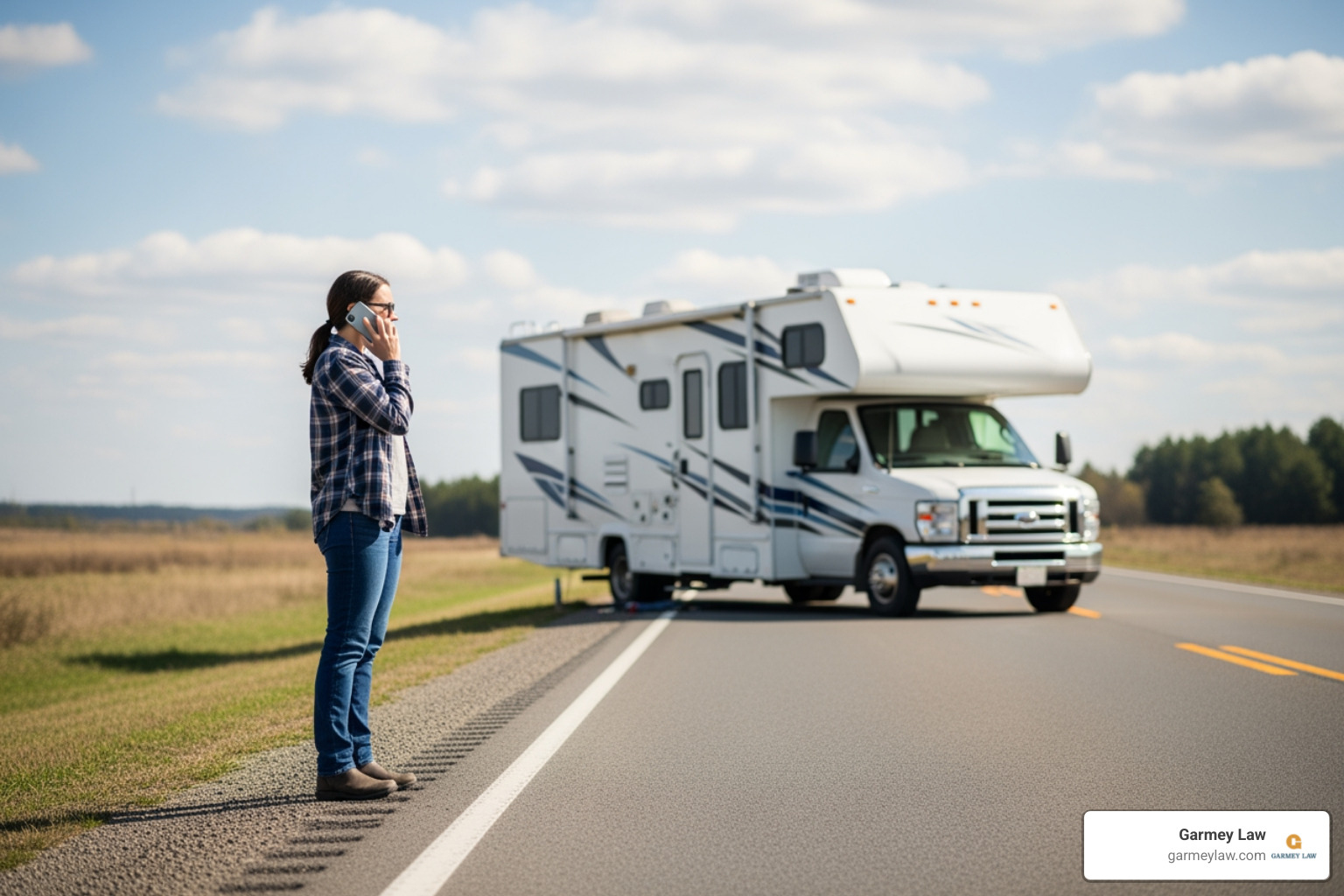
Immediate Actions at the Scene
Your first priority is safety. After that, focus on documentation.
- Ensure Safety and Call 911: Check on yourself and your passengers. If you can, move to a safe location away from traffic. Call 911 immediately to request police and medical assistance. The official police report is a critical piece of evidence.
- Document the Scene: Use your phone to take extensive photos and videos. Capture vehicle damage, road conditions, skid marks, traffic signs, and any visible injuries.
- Exchange Information: Get the other driver’s name, contact information, driver’s license number, and insurance details. If the RV is a rental or commercial vehicle, note the company’s name and any identifying numbers on the vehicle.
- Talk to Witnesses: If there are any witnesses, ask for their names and contact information. Independent testimony can be invaluable.
- Do Not Admit Fault: Avoid saying things like “I’m sorry.” Such statements can be used against you by insurance companies, even if you were not at fault. Let the investigation determine liability.
Protecting Your Health and Your Claim
After leaving the scene, continue to take steps to protect your well-being and your legal rights.
- Seek Medical Attention Immediately: Even if you feel fine, get a medical evaluation. Some serious injuries have delayed symptoms. A doctor’s visit creates a crucial medical record linking your injuries to the crash.
- Report the Accident to Your Insurer: You must notify your insurance company, but you are not obligated to give a recorded statement or sign documents before consulting an RV accident lawyer.
- Keep Detailed Records: Start a file for everything related to the accident. Save all medical bills, repair estimates, and receipts. Document your lost wages and keep a daily journal describing your pain and how the injuries affect your life.
- Follow Your Doctor’s Orders: Attend all appointments and follow your treatment plan precisely. Gaps in care can be used by insurers to argue that your injuries aren’t serious.
- Never Speak to the Other Insurer Alone: Do not give a recorded statement to the at-fault party’s insurance adjuster without your lawyer present. They are trained to ask questions designed to devalue your claim.
Why You Need an Experienced RV Accident Lawyer
After an RV accident, you’re facing powerful insurance companies whose goal is to pay as little as possible. You are the underdog. At Garmey Law, we level the playing field. Our aggressive, compassionate approach is designed to fight for individuals against large corporations, ensuring you get the compensation you deserve.
An experienced RV accident lawyer handles the complex legal battle so you can focus on healing. We understand the unique challenges of these cases—from overlapping insurance policies to manufacturing defects—and have the expertise to steer them successfully.
How an RV Accident Lawyer Builds Your Case
Building a strong RV accident claim requires a proactive and thorough approach. We immediately take action to:
- Conduct a Thorough Crash Investigation: We go beyond the initial police report, visiting the scene to gather evidence that may have been missed.
- Collect and Preserve Evidence: We secure medical records, witness statements, maintenance logs, and black box data that can reveal critical details about the crash.
- Consult with Experts: We work with accident reconstructionists, medical professionals, and vocational experts whose testimony can prove how the crash happened and the full extent of your losses.
- Identify All Liable Parties: We dig deep to find every person or entity that contributed to your accident—the driver, owner, rental company, manufacturer, or maintenance shop—to maximize your potential sources of compensation.
- Prove Negligence: We connect the evidence to show that a party’s carelessness directly caused your injuries. Our work on cases involving legal recourse for defective recreational vehicles demonstrates our ability to handle these complexities.
Maximizing Your Compensation
The first settlement offer from an insurance company is rarely fair. An RV accident lawyer ensures you are compensated for the full extent of your damages.
We calculate all economic damages, including current and future medical expenses, lost wages, and diminished earning capacity. We also pursue non-economic damages to compensate for your physical pain and suffering, emotional distress, and the impact on your family relationships (loss of consortium). We handle all negotiations with a clear message: we know the true value of your case and are prepared for trial if a fair offer isn’t made. You can learn more about our approach to motor vehicle accident claims.
Understanding the Statute of Limitations
In every state, there is a strict deadline, known as the statute of limitations, for filing a lawsuit. If you miss this deadline, you lose your right to seek compensation forever. These time limits vary by state and the type of claim.
Because evidence disappears and memories fade, it is crucial to act quickly. Contacting an RV accident lawyer promptly ensures your rights are protected and that all deadlines are met while we build the strongest possible case for you.
Frequently Asked Questions about RV Accident Claims
After an RV accident, it’s natural to have questions. Here are answers to some of the most common concerns we hear from clients.
What types of damages can I recover in an RV accident claim?
Under Maine law, you can seek compensation for all your losses. This includes economic damages (medical bills, lost income, property damage) and non-economic damages (pain and suffering, emotional distress, loss of consortium). In some cases of extreme negligence or defective products, punitive damages may also be available. We conduct a thorough evaluation to ensure every loss is accounted for.
What if I was a passenger in the RV that caused the crash?
As a passenger, you almost certainly bear no fault for the accident and have every right to seek compensation for your injuries. This is true even if a friend or family member was driving. Your claim is typically made against an insurance policy—not the individual directly. Depending on the circumstances, we can pursue a claim against the RV driver’s insurance, another at-fault driver’s policy, or even the RV manufacturer. We can help you steer this sensitive situation with professionalism.
How much does it cost to hire an RV accident lawyer?
Hiring an experienced RV accident lawyer at our firm costs you nothing upfront. We work on a contingency fee basis, which means our fee is a percentage of the compensation we recover for you. If we don’t win your case, you owe us nothing. This arrangement allows you to access top-tier legal representation without any financial risk, ensuring your focus remains on your recovery. Our interests are aligned with yours: we only succeed when you do.
Taking the First Step Towards Justice
The path to recovery after an RV accident is complex and challenging. You’re facing unique legal problems and large insurance companies dedicated to minimizing your claim. You should not have to face them alone.
At Garmey Law, we are committed to representing the underdog. We provide the aggressive, compassionate legal representation needed to fight powerful opponents and secure the compensation you deserve. An experienced RV accident lawyer will handle the legal battle, allowing you to focus on what matters most: your healing.
Time is critical. Evidence can be lost, and strict legal deadlines apply. Taking the first step is essential to protecting your rights. If you or a loved one has been injured in an RV accident, we invite you to contact us for a free consultation. Let’s discuss how we can help you achieve justice.
Contact us about your recreational vehicle accident and let us fight for your recovery.