Understanding Your Rights After a Drunk Driving Collision
Crashes caused by drunk drivers are among the most devastating and preventable sources of injuries on America’s roads. If you or a loved one has been hurt by an impaired motorist, it’s important to understand your legal rights and what steps to take right away.
The statistics are staggering. Every day in America, 37 people are killed and more than 1,000 are injured in drunk driving crashes, according to the National Highway Traffic Safety Administration. In 2020 alone, 11,654 people died in alcohol-impaired collisions, accounting for about 30% of all traffic fatalities. These deaths were all preventable.
When a drunk driver hits you, the consequences extend far beyond physical injuries. Victims often face mounting medical bills, lost wages, property damage, and long-term disabilities. The emotional trauma can be equally devastating. Many survivors struggle with anxiety, depression, and post-traumatic stress as they steer both recovery and the complex legal system.
Unlike typical car accidents, drunk driving cases involve unique legal considerations. The drunk driver may face criminal charges separately from your civil claim for compensation. You may be entitled to punitive damages designed to punish the driver’s reckless conduct. Third parties like bars or restaurants that overserved the driver might also share liability under dram shop laws.
Insurance companies often use aggressive tactics to minimize payouts, even when their insured driver was clearly intoxicated and at fault. They may offer quick, lowball settlements before you understand the full extent of your injuries. They might question whether the driver’s intoxication actually caused the crash. Without experienced legal representation, victims risk accepting far less compensation than they deserve.
Immediate Steps to Take at the Accident Scene
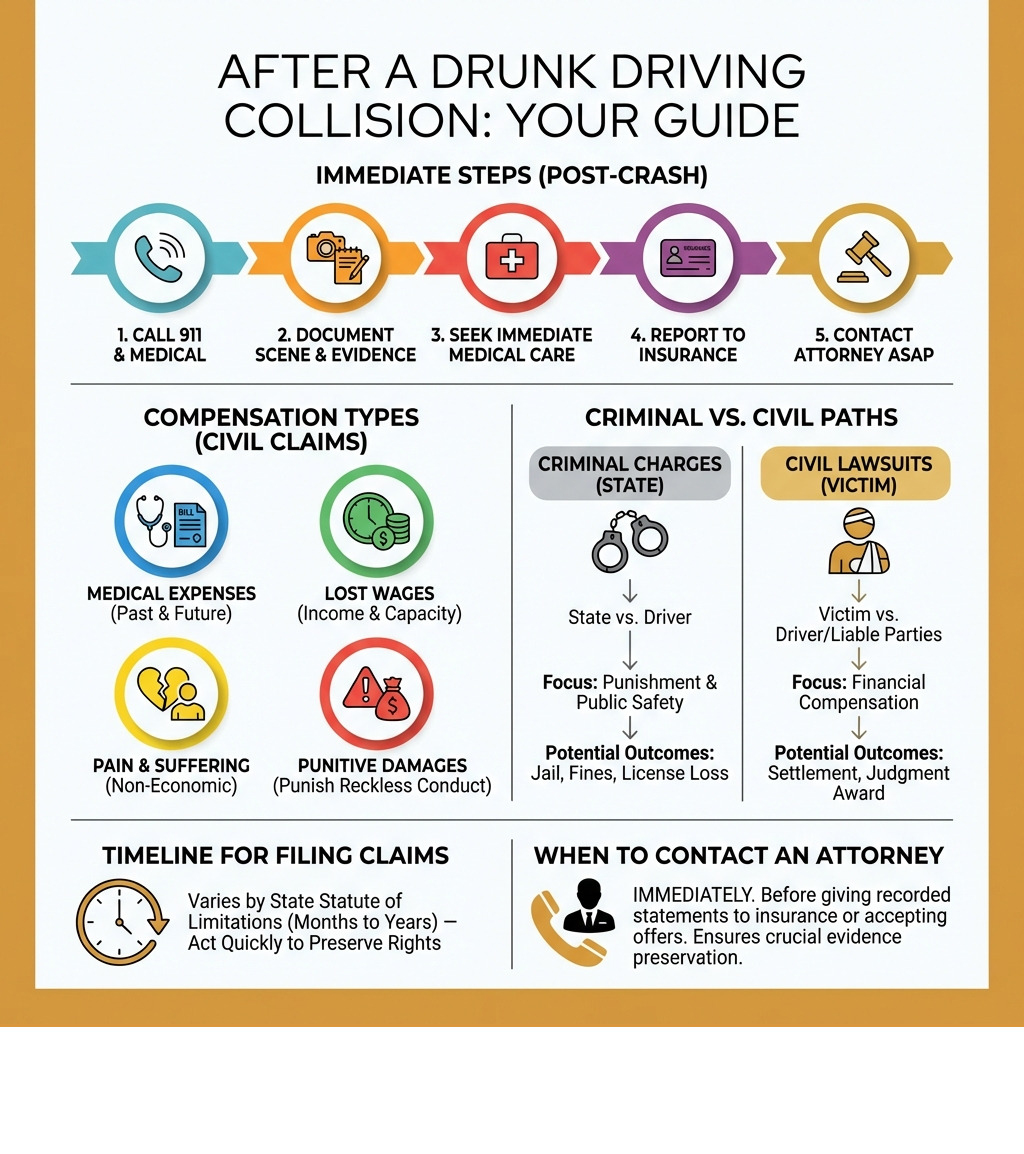
The moments following a collision with a drunk driver are often a blur of adrenaline, confusion, and fear. However, the actions we take in these first few minutes can significantly impact our ability to seek justice later. At Garmey Law, we’ve seen how crucial “on-the-scene” evidence can be for our clients in Portland, Saco, and across Maine.
Safety and the 911 Call
Your first priority is safety. If possible, move your vehicle to the side of the road and turn on your hazard lights. Check yourself and your passengers for injuries. Even if you feel “fine,” remember that adrenaline is a powerful natural painkiller. It can mask serious issues like internal bleeding or whiplash.
Call 911 immediately. In Maine, reporting an accident is not just a safety measure; it is often a legal requirement. When the police arrive, they will create an official crash report. This report is a cornerstone of any Car Accidents claim. If you suspect the other driver is intoxicated, tell the dispatcher and the responding officer. This ensures the police perform the necessary field sobriety tests and breathalyzer exams.
Gathering Evidence
If you are physically able, use your smartphone to document the scene. While the police will do their own investigation, having your own records is invaluable. We recommend capturing:
- The Other Driver’s Behavior: Note if they are slurring their speech, stumbling, or attempting to discard containers or eye drops.
- Vehicle Positioning: Take photos of the damage to both vehicles and their final resting spots.
- The Environment: Capture skid marks, weather conditions, and any obscured traffic signs.
- Witness Information: If anyone stopped to help, get their names and phone numbers. Their objective testimony can be the difference between a “he-said, she-said” situation and a clear-cut case of liability.
For more detailed advice on handling the aftermath of a collision, you can explore our Car Accidents Blog Category.
Proving Liability When Hit by a Drunk Driver
In a standard personal injury case, we have to prove that the other driver was negligent. However, when someone is hit by a drunk driver, the legal concept of “negligence per se” often applies. This means that because the driver broke a safety law (driving while intoxicated), they are often presumed to be negligent. This is not always the case, but that presumption is difficult to overcome.
Under Maine law, Operating Under the Influence (OUI) is defined as operating a motor vehicle with a blood alcohol concentration (BAC) of 0.08% or higher. For drivers under 21, Maine has a “zero tolerance” policy—any detectable amount of alcohol can lead to a license suspension.
To win your case, we must prove:
- Duty: The driver owed you a duty to drive safely.
- Breach: They breached that duty by driving drunk.
- Causation: Their impairment was the proximate cause of the accident.
- Damages: You suffered actual injuries or losses.
Establishing Motor Vehicle Accidents liability can sometimes be tricky if the defense argues that your actions contributed to the crash. For example, if you were speeding when the drunk driver pulled out in front of you, the insurance company might try to shift some of the blame. This is why having an aggressive legal team is essential to protect your interests.
Seeking Justice if You Were Hit by a Drunk Driver Without Insurance
It is a nightmare scenario: you are injured by a drunk driver, only to find out they have no insurance or were driving a stolen vehicle. In Maine, we have protections in place for this.
Uninsured/Underinsured Motorist Coverage (UM/UIM): This is a portion of your own auto insurance policy designed to step in when the at-fault driver can’t pay. Many people are hesitant to file a claim against their own insurance, fearing their rates will skyrocket. However, this is exactly what you pay your premiums for. And, if the other driver was uninsured or underinsured to cover your damages, filing a UM/UIM claim will not impact your insurance rates or negatively affect your insurance premiums or insurance record. It exists as coverage specifically for that reason, and we often tell our clients to max out their UM/UIM coverage to protect themselves and their families from irresponsible people who drive vehicles without insurance.
If the drunk driver fled the scene (a hit-and-run), your UM coverage is often your primary path to recovery. Our team at Garmey Law also performs deep-dive asset investigations. Even if a driver lacks insurance, they may have personal assets—like real estate or savings—that can be reached through a court judgment and orders enforcing the award.
To learn more about navigating insurance complexities, visit our Motor Vehicle Accidents Blog Category.
Legal Options and Compensation After Being Hit by a Drunk Driver
When we represent regular people against big insurance companies, our goal is to ensure the compensation reflects the true cost of the accident. This includes both the bills you have on your desk today and the challenges you will face ten years from now.
Economic vs. Non-Economic Damages
Victims of drunk driving are entitled to several types of compensation:
- Economic Damages: These are quantifiable financial losses. They include Medical expenses (hospital stays, surgeries, physical therapy), Lost wages, and property damage to your vehicle.
- Non-Economic Damages: These are more subjective but often more impactful. They include Pain and suffering, emotional distress, loss of enjoyment of life, and “loss of consortium” (the impact on your relationship with your spouse).
In the most tragic cases where a Hit by a drunk driver incident results in a fatality, we pursue Wrongful Death claims to help families cover funeral costs and the loss of future financial support and companionship.
Criminal Charges vs. Civil Lawsuits
It is a common misconception that if the drunk driver goes to jail, the victim’s “case” is over. In reality, these are two completely separate tracks.
| Feature | Criminal Case | Civil Lawsuit |
|---|---|---|
| Purpose | To punish the driver for breaking the law. | To compensate the victim for their losses. |
| Brought By | The State of Maine (District Attorney). | The Victim (with a private attorney). |
| Burden of Proof | beyond a reasonable doubt (Very High). | Preponderance of the evidence (More likely than not). |
| Outcome | Jail, fines, license suspension. | Monetary settlement or jury verdict. |
Even if the driver is acquitted in criminal court, we can still win a civil case because the burden of proof is lower.
Recovering Punitive Damages
In some cases, the court may award punitive damages. Unlike compensatory damages, which are meant to “make the victim whole,” punitive damages are meant to punish the defendant for particularly egregious or reckless behavior.
Drunk driving is a prime example of circumstances that would justify issuing punitive damages because oftentimes the driver made a conscious, reckless choice to get behind the wheel while impaired. In Maine, proving punitive damages requires showing “malice,” which can be difficult but is possible in cases involving high BAC levels or repeat offenders. If the person’s conduct clearly shows they were indifferent toward the value of human life, or their conduct shocks the conscience of a reasonable person, then punitive damages may be available. We believe in holding drivers accountable to the fullest extent of the law to deter others in the community from making the same dangerous choices.
For more on how we handle these specific types of claims, see our section on Car Accidents.
Third-Party Liability and Insurance Tactics
Sometimes, the driver isn’t the only one at fault. Maine law allows us to look at the “chain of events” that led to the intoxication.
Dram Shop and Social Host Liability
Under the Maine Liquor Liability Act, a business that serves alcohol (like a bar in the Old Town district or a restaurant in South Portland) can be held liable if they served a “visibly intoxicated” person who then caused a crash. This is known as a Dram Shop claim. If a Dram Shop claim is plausible the timeframe under Maine Law to provide notice of that claim is very short.
Under Maine’s Liquor Liability Act, 28-A M.R.S.A. 2513, a claimant must provide written notice of a dram shop claim to the alcohol server/establishment within 180 days of the incident. The lawsuit must generally be filed within two years of the injury. Failure to provide timely notice can result in dismissal. An extension of this 180 notice timeframe is possible, but to succeed the claimant must show good cause as to why notice could not have reasonably been filed within the 180day limit. “Good cause” includes but is not limited to the inability of the claimant to obtain investigative records from a law enforcement officer or law enforcement agency.
Similarly, “Social Host Liability” may apply if an individual provides alcohol to a minor who then gets behind the wheel. These third-party claims are vital because bars and businesses often have much larger insurance policies than individual drivers, ensuring there are enough funds to cover catastrophic injuries.
Employer Liability (Respondeat Superior)
If the person who hit you was a “drunk sales rep” or an employee on the clock, the employer might be responsible under the doctrine of respondeat superior. Even if they were driving their personal car, if they were performing work duties (like driving to a client meeting in Scarborough or Westbrook), the company’s insurance may be on the hook.
Navigating Insurance Tactics
Insurance companies are not in the business of being “good neighbors” when a high-value claim is on the line. They often use the following tactics:
- The Quick Settlement: Offering a few thousand dollars days after the crash. If you sign, you waive your right to sue forever—even if you later find out you need surgery.
- Blame-Shifting: Suggesting you were distracted or that your injuries were “pre-existing.”
- Delaying: Waiting months to respond to letters, hoping you’ll become desperate for cash and accept a lower offer.
We handle all communication with the insurance companies so you don’t have to. We’ve dealt with these adjusters for decades, and they know that if they don’t offer a fair settlement, we are ready to take them to court. This is especially true in cases involving Motorcycle Accidents or other high-stakes collisions. You can read more about these challenges in our Motorcycle Accidents Blog Category.
Frequently Asked Questions About Drunk Driving Accidents
How is my settlement value determined?
There is no “average” settlement because every life is different. We calculate value based on:
- Medical Bills: Both current and estimated future costs (like home modifications for a disability).
- Lost Earning Capacity: If you can no longer work in your chosen field in Cape Elizabeth or Falmouth, that loss of future income must be compensated.
- The Severity of Negligence: A driver with a 0.25% BAC may lead to higher awards than one just over the limit.
- Permanence: A permanent scar or a lifelong limp significantly increases the value of non-economic damages.
Our team, including experts like Peter Richard, spends hundreds of hours building a “damages profile” for each client to ensure no stone is left unturned.
Do I have to go to court to get compensation?
Statistically, 80-90% of personal injury cases settle before reaching a jury. However, the best way to get a high settlement is to prepare for a trial. When the insurance company sees that we have hired accident reconstruction experts and prepared depositions, they are much more likely to offer a fair number. If they don’t, we are more than comfortable presenting your story to a Maine jury.
What is the statute of limitations for a drunk driving claim in Maine?
In Maine, the general statute of limitations for a personal injury claim is six years. However, if the accident resulted in a fatality, the Wrongful Death statute of limitations is much shorter—typically two years.
Additionally, if you are suing a government entity (like a city-owned vehicle in Portland) or bringing a Dram Shop claim against a bar, there are very strict “notice” requirements that must be met within 180 days. Missing these deadlines can end your case before it begins. This is why you should contact an attorney immediately. You can see our accolades in this field, such as the Peter Richard Motor Vehicle Accident Top 25.
Get Help After a Drunk Driving Crash in Maine
Being hit by a drunk driver is a life-altering event that brings up feelings of anger, injustice, and physical pain. But you don’t have to carry this burden alone. At Garmey Law, we specialize in representing the “underdogs”—the individuals and families who have been pushed aside by powerful interests.
Whether you are in Portland, Biddeford, or Brunswick, our team provides the aggressive, compassionate advocacy you need to hold reckless drivers and negligent businesses accountable. We operate on a contingency fee basis, meaning we don’t get paid unless you do. We believe that everyone deserves top-tier legal representation, regardless of the size of their bank account.
Don’t let an insurance adjuster dictate the value of your recovery. Protect your rights by contacting an experienced car accident attorney today for a free, no-obligation consultation. Let us fight for the justice you and your family deserve.