

When a Heart Attack Gets Missed: What You Need to Know
Heart attack misdiagnosis happens more often than most people realize — and the consequences can be devastating.
Here is a quick overview of what that means:
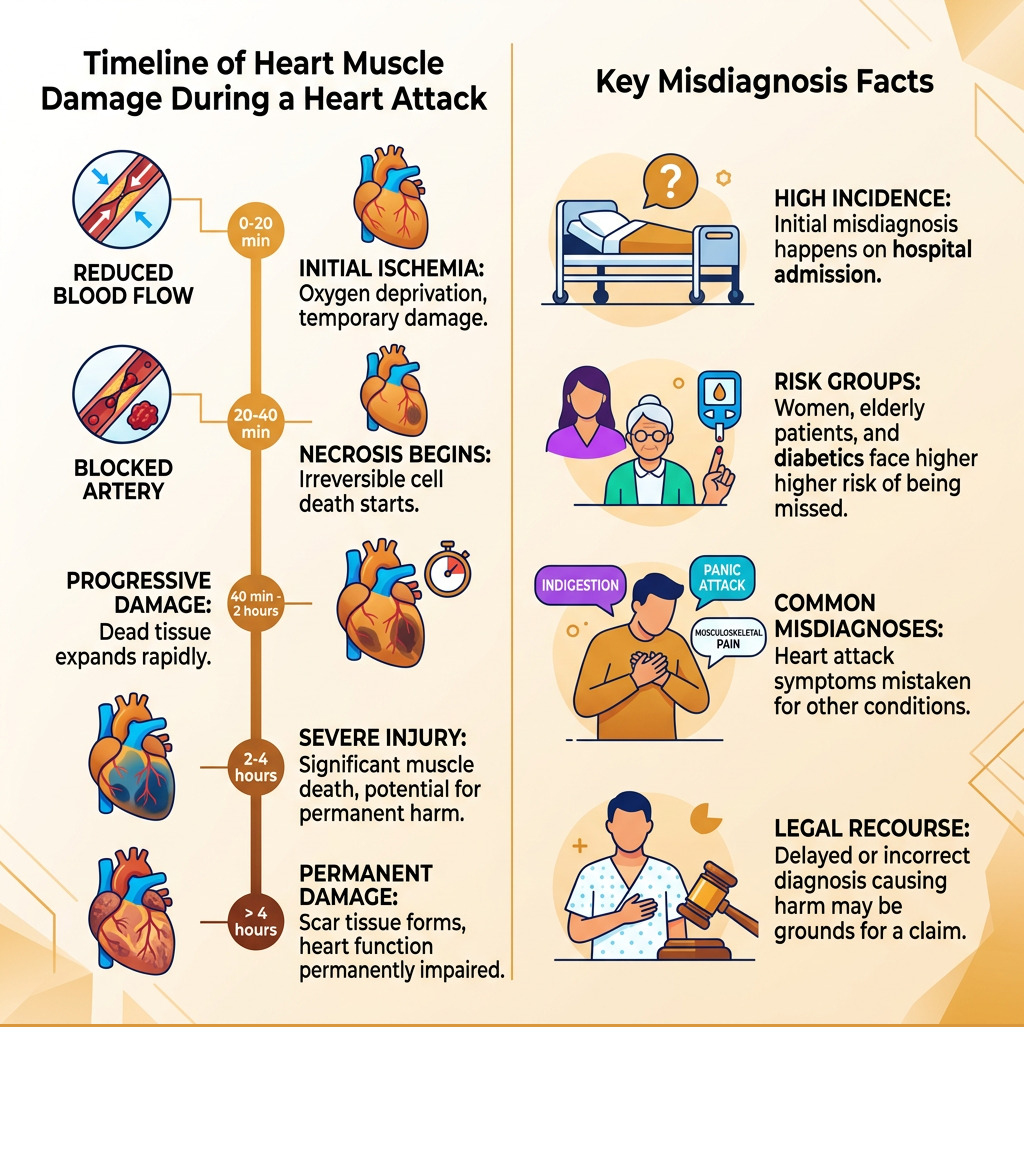
- A heart attack is misdiagnosed when doctors fail to identify it correctly, either sending a patient home without treatment or labeling the event as something less serious
- Around 30% of heart attacks are initially misdiagnosed on hospital admission
- Women, elderly patients, and diabetics face the highest risk of being missed
- Common misdiagnoses include indigestion, panic attacks, and musculoskeletal pain
- A missed heart attack can lead to permanent heart damage, heart failure, or death
- If a medical professional’s failure to diagnose caused you greater harm, you may have a medical negligence claim
Consider the case of Alison Fillingham, a nurse who felt pain in her collarbone and neck. She assumed it was stress and went to work. When the pain spread to her jaw, paramedics told her it was a panic attack. Only hours later, at the hospital, was she correctly diagnosed with a heart attack — a delay that could have cost her life.
Her story is not unique. One in three heart attack patients receives the wrong diagnosis at first.
Our attorneys at Garmey Law have experience in medical malpractice cases, including heart condition misdiagnosis claims where delayed or incorrect diagnosis caused serious, life-altering harm. If you or someone you love has been affected, understanding how these errors happen — and what your legal options are — is the critical first step.
Defining Myocardial Infarction and Its Primary Types
To understand how a heart attack misdiagnosis occurs, we first need to look at what is actually happening inside the body. A heart attack, or myocardial infarction (MI), occurs when the blood flow that brings oxygen to the heart muscle is severely reduced or cut off completely. This happens because the coronary arteries that supply the heart can become narrow from a buildup of fat, cholesterol, and other substances (plaque).
Medical professionals categorize these events under the umbrella of Acute Coronary Syndrome (ACS). There are three primary types that doctors must differentiate between to provide the correct treatment:
- STEMI (ST-Elevation Myocardial Infarction): This is the “classic” and most severe heart attack. It involves a total blockage of a coronary artery. On an electrocardiogram (ECG), it shows a specific abnormality called ST-segment elevation. Because the blockage is total, the heart muscle begins to die quickly, requiring immediate intervention like surgery or “clot-busting” drugs.
- NSTEMI (Non-ST-Elevation Myocardial Infarction): This is actually more common than a STEMI. In an NSTEMI, the blockage is partial or temporary. While the ECG might not show the classic “elevation” seen in a STEMI, blood tests will show elevated enzymes (troponin) indicating that heart muscle damage has occurred.
- Unstable Angina: This is the least severe form of ACS but acts as a major warning sign. It involves reduced blood flow but no actual muscle death yet. If left untreated, unstable angina can quickly progress to a full-blown STEMI.
| Characteristic | STEMI | NSTEMI | Unstable Angina |
|---|---|---|---|
| Blockage Level | Total/Complete | Partial/Temporary | Partial |
| ECG Changes | ST-Elevation present | No ST-Elevation | No ST-Elevation |
| Troponin Levels | Elevated | Elevated | Normal |
| Muscle Damage | Severe/Immediate | Present | None yet |
Why Heart Attack Misdiagnosis Occurs in Emergency Settings
One of the primary culprits is the misinterpretation of the ECG. While the ECG is a vital tool, it is not foolproof. In fact, an initial 12-lead ECG can be non-diagnostic in 45% of ACS patients and completely normal in 20% of cases. If a doctor relies solely on that first “clear” reading and fails to repeat the test when symptoms persist, a heart attack misdiagnosis is almost inevitable.
Another factor is the timing of troponin tests. Troponin is a protein released into the bloodstream when the heart muscle is damaged. However, these levels may not rise for several hours. If a hospital discharges a patient after only one normal blood test without waiting for a follow-up “serial” troponin draw, they may be sending a patient home in the middle of an evolving heart attack.
At Garmey Law, we often see that understanding diagnostic errors in healthcare is the first step toward holding negligent parties accountable. When hospitals fail to follow established triage protocols—such as performing an ECG within 10 minutes of arrival—the risk of a tragic error skyrockets.
Common Conditions Mistaken for a Heart Attack
A major reason for heart attack misdiagnosis is that the symptoms often mimic less serious conditions. Doctors may “anchor” on a benign diagnosis and stop looking for other causes. Common “look-alike” conditions include:
- Indigestion or Acid Reflux: Many patients, especially those without classic chest pain, describe a burning sensation or “fullness” that doctors dismiss as heartburn.
- Panic Attacks: Because heart attacks cause acute anxiety and shortness of breath, they are frequently mislabeled as psychiatric issues, particularly in younger patients or women.
- Musculoskeletal Pain: Pain in the chest wall, ribs, or shoulders is often blamed on a pulled muscle or “heavy lifting,” even when the patient has cardiac risk factors.
- Gastrointestinal Disease: Gallbladder issues or stomach ulcers can cause pain in the upper abdomen that feels remarkably similar to a heart attack.
If you are wondering whether your doctor failed to diagnose a serious condition in time, it may be because they chose the “easy” diagnosis over the correct one.
The Role of Overdiagnosis in Heart Attack Misdiagnosis
Interestingly, the medical community is now grappling with the opposite problem: overdiagnosis. This happens because modern troponin tests have become incredibly sensitive. While they rarely miss a heart attack, they often pick up “myocardial injury” that isn’t actually a heart attack.
As Harvard research on heart attack overdiagnosis points out, troponin can be elevated due to chronic kidney disease, heart failure, or even COVID-19-related myocarditis. If a doctor diagnoses a heart attack based only on a blood test without looking at the whole clinical picture, such as ECG changes or ultrasound results, a patient might undergo unnecessary, risky procedures like catheterization. This “false positive” is also a form of misdiagnosis that can lead to physical and financial hardship.
Who Is Most at Risk for a Missed Diagnosis?
The “classic” heart attack patient—a middle-aged man clutching his chest—is well recognized. But many people don’t fit that mold. Research shows that certain groups are much more likely to suffer a heart attack misdiagnosis.
- Women: Women are 50% more likely to be misdiagnosed than men. A study in England and Wales found that women with a final diagnosis of STEMI had a 59% greater chance of an initial misdiagnosis compared to men.
- Diabetics: Diabetes can cause nerve damage (neuropathy), which “mutes” pain signals. A diabetic patient might not feel any chest pain at all, presenting only with shortness of breath or nausea.
- The Elderly: Older patients often have multiple comorbidities that cloud the diagnostic picture. Their symptoms are frequently attributed to “just getting older” or existing chronic conditions.
- Rural Hospitals: Smaller facilities may lack the specialized cardiac equipment or 24/7 cardiology staff found in larger cities like Portland, leading to higher miss rates.
As one Garmey Law article explains, Mayo Clinic research found alarming numbers of patients suffer from misdiagnosis, highlighting that diagnostic errors are a systemic issue that requires patients to be their own strongest advocates.
Atypical Symptoms and Heart Attack Misdiagnosis in Women
For decades, medical training focused on “crushing chest pain.” We now know that women often experience a different set of symptoms. When a woman presents without the “Hollywood” chest clutch, doctors are significantly more likely to miss the signs.
Common atypical symptoms include:
- Unexplained fatigue or “flu-like” symptoms.
- Pain in the jaw, neck, or upper back.
- Nausea and vomiting.
- Shortness of breath without chest discomfort.
A study on gender disparities in heart attack diagnosis confirms that these “atypical” presentations are a major driver of the higher mortality rates seen in female heart attack victims. When these symptoms are dismissed as “stress” or “anxiety,” the window for life-saving treatment slams shut.
The Consequences of Delayed Treatment and Medical Negligence
Time is muscle. Every minute that a heart attack goes undiagnosed, more heart tissue dies. The consequences of a heart attack misdiagnosis are often permanent:
- Heart Failure: If a large portion of the heart muscle dies, the heart can no longer pump blood efficiently. This leads to chronic shortness of breath, swelling, and a severely limited quality of life.
- Arrhythmias: Scar tissue on the heart can disrupt electrical signals, leading to dangerous irregular heartbeats.
- Myocardial Scarring: Unlike skin, heart muscle does not regrow. It is replaced by stiff scar tissue that weakens the heart’s structure.
- Higher Mortality: Patients who are initially misdiagnosed and sent home have a significantly higher risk of dying within the next 30 days compared to those who are admitted and treated immediately.
Diagnostic errors in healthcare can qualify as malpractice. If a doctor in Maine fails to follow the standard of care, such as ignoring a patient’s risk factors or failing to order an ECG, and that failure leads to these permanent injuries, it is likely a matter of legal liability.
Proving Negligence in a Heart Attack Misdiagnosis Case
Not every missed diagnosis is malpractice. Medicine is difficult, and sometimes symptoms are truly deceptive. However, to win a medical malpractice case in Maine, we must prove three things:
- Duty of Care: The doctor or hospital had a legal obligation to provide treatment that meets the “standard of care.”
- Breach of Duty: The medical professional acted, or failed to act, in a way that a reasonably competent doctor in the same specialty would not have. For example, failing to repeat a troponin test when a patient still has chest pain is often a breach.
- Causation: We must prove that the misdiagnosis caused the harm. This is often the hardest part. We have to show that if the diagnosis had been made on time, the outcome would have been significantly better.
Understanding the difference between medical malpractice and negligence is crucial. Negligence is the mistake; malpractice is the legal claim that arises when that mistake causes serious injury.
Frequently Asked Questions About Heart Attack Misdiagnosis
How common is heart attack misdiagnosis?
While some systematic reviews, including an AHRQ systematic review of AMI misdiagnosis, suggest a 1-2% error rate in specialized settings, broader studies of hospital admissions show that nearly 30% of heart attacks are initially misdiagnosed. This means the doctor’s first guess was wrong nearly a third of the time. If you feel something is wrong, do not be afraid to speak up. Knowing what to expect when suing for medical malpractice can help you understand the gravity of these “common” errors.
What should I do if I suspect a heart attack misdiagnosis?
If you are in the ER and feel your symptoms are being dismissed:
- Ask for a Second Opinion: Request to speak with a cardiologist or the attending physician.
- Insist on Repeat Testing: If your first ECG or troponin test was normal but the pain continues, ask for a repeat test. Levels can take hours to change.
- Describe Your Pain Accurately: Mention any radiation to the jaw or arms, and be clear about your risk factors, such as smoking, family history, and diabetes.
- Request Your Records: If you are sent home and later find out you had a heart attack, obtain your medical records immediately. These are the “black box” of your treatment.
Can I seek compensation for a missed heart attack?
Yes. Compensation can cover medical bills, lost wages, and noneconomic damages like pain, suffering, and loss of enjoyment of life. In some cases, the settlements can be substantial. For instance, our firm handled a misdiagnosis case that led to a $1.9 million paralysis settlement for a Maine girl. While every case is different, the principle remains: when the system fails you, the law provides a way to seek justice.
Talk to a Maine Medical Malpractice Lawyer About a Missed Heart Attack
A heart attack misdiagnosis is more than just a medical “oops”—it is a life-altering event that can leave families devastated and survivors struggling with chronic illness. Whether it stems from a failure to recognize atypical symptoms in a woman or a rushed discharge from a rural Maine ER, these errors often come down to a failure to follow the basic standards of care that keep patients safe.
At Garmey Law, we believe in representing the “underdogs.” We take an aggressive, compassionate approach to every case, ensuring that hospitals and doctors are held accountable when they prioritize speed over patient safety. We serve clients throughout Maine, from Portland and South Portland to Freeport and Kennebunkport.
If you or a loved one has suffered because a heart attack was missed or delayed, you don’t have to navigate the complex world of medical malpractice alone. Contact Garmey Law for a medical malpractice consultation today. We are here to listen to your story, evaluate your records, and help you fight for the compensation and answers you deserve.