

When Tragedy Strikes Maine’s Roads
Fatal car accidents in Maine have claimed hundreds of lives in recent years, leaving families searching for answers and communities in mourning. Here’s what you need to know based on data from the Maine Crash Reporting System for 2017-2021:
- 719 accidents in Maine resulted in fatalities
- The 50-59 age group faces the highest risk of fatal outcomes
- Going off the road accounts for 49.10% of fatal crashes
- Two recent tragedies in New Gloucester and Falmouth highlight ongoing risks
- Families have legal options through wrongful death claims
Maine’s roadways can be dangerous. Recent crashes have taken loved ones from families across the state. A two-vehicle collision on the Maine Turnpike in New Gloucester killed two adults and injured four children when a detached trailer remained in the roadway. A young driver lost her life in Falmouth when snowy weather sent her car into a guardrail.
These tragedies are not isolated events. They represent a pattern of preventable deaths on our roads. Understanding what causes these crashes and what legal recourse exists can help families find a path forward after an unthinkable loss.
Understanding the Statistics Behind a Fatal Car Accident in Maine
While individual stories are heartbreaking, understanding the broader statistical landscape helps us identify patterns and risks. According to the Maine Crash Reporting System, from 2017 to 2021, Maine experienced a significant number of auto accidents, many resulting in serious injuries and fatalities.

Accident Trends by Time and Demographics
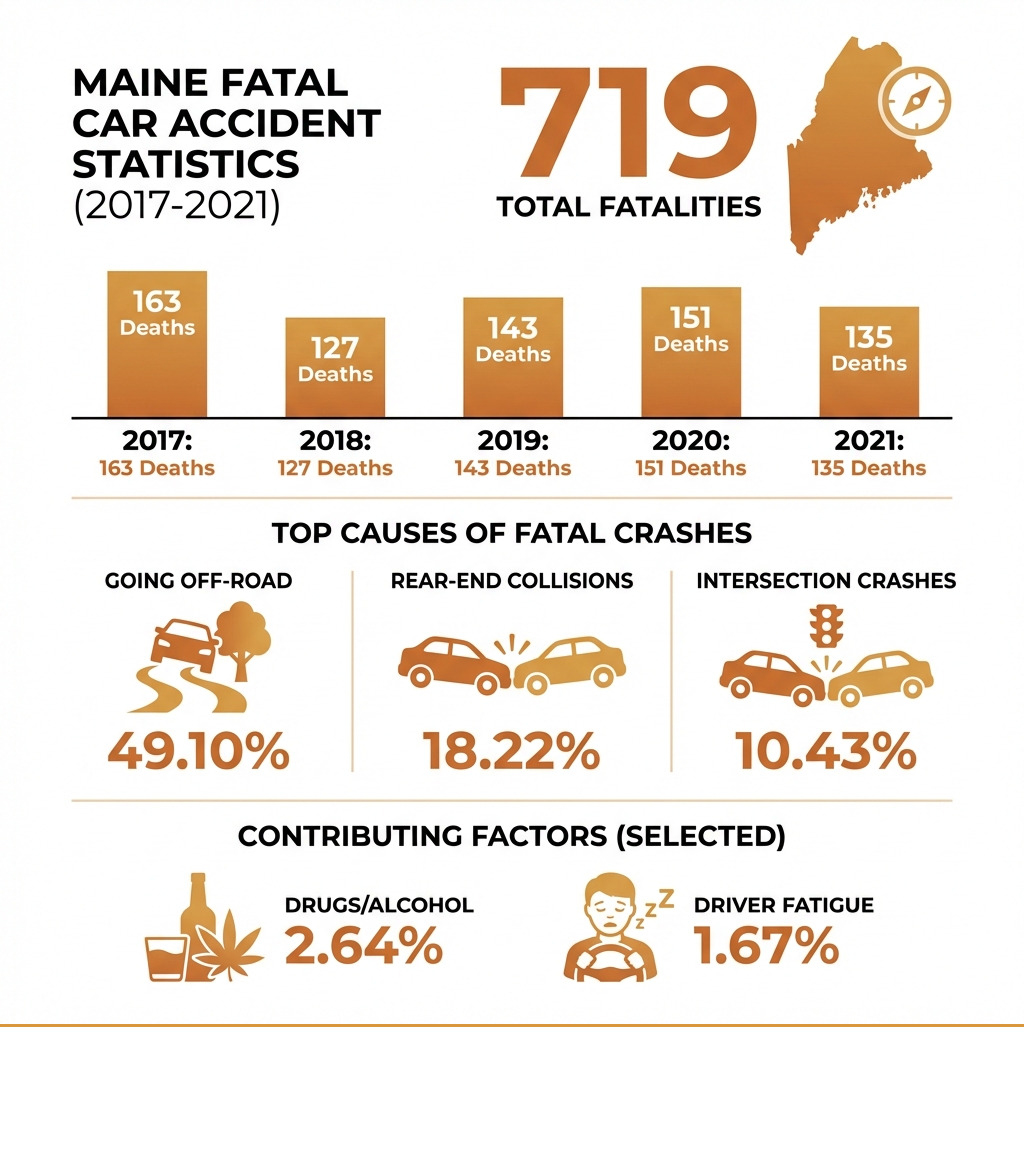
During the five-year period from 2017 to 2021, Maine recorded 166,842 total auto accidents. Out of these, 38,889 resulted in injuries, with 2,927 classified as severe. Tragically, 719 accidents during this time involved fatalities. The number of fatalities fluctuated annually:
- 2017: 163 fatalities
- 2018: 127 fatalities
- 2019: 143 fatalities
- 2020: 151 fatalities
- 2021: 135 fatalities
Certain times of the year and week see higher accident rates. December had the highest number of accidents, closely followed by November and January. This suggests a strong correlation with winter weather and holiday travel. Fridays were the worst days for accidents, with Thursdays and Wednesdays also seeing high numbers. Interestingly, most accidents (63.44%) occurred during daylight hours, while 21.48% happened in dark, unlighted conditions. This could indicate a false sense of security or increased traffic during daylight.
When looking at age groups, the 30-39 age group was involved in the most accidents overall. However, the picture changes for fatal crashes. The 50-59 age group had the highest number of fatal accidents (121 crashes), closely followed by the 60-69 age group (119 fatal crashes). The 30-39 age group also had a significant number of fatal crashes (112), indicating that while younger drivers might be involved in more incidents, older drivers face a higher risk of fatal outcomes.
Key Differences: Fatal vs. Non-Fatal Crashes
Understanding what distinguishes a fatal crash from a non-fatal one is crucial for prevention efforts. While many factors contribute to all accidents, some are disproportionately represented in fatal incidents.
| Factor/Type | Fatal Accidents (2017-2021) | All Accidents (2017-2021) |
|---|---|---|
| Going off the road | 49.10% | 25.37% |
| Rear-end/Sideswipe collisions | 18.22% | 32.08% |
| Intersection crashes | 10.43% | – |
| Failure to yield right of way | – | Top factor |
| Following too closely | – | Second top factor |
This table highlights a critical difference: nearly half of all fatal crashes involved vehicles going off the road. While off-road accidents are common overall, their severity is significantly higher. Rear-end and sideswipe collisions are the most common type of accident, but they account for a smaller percentage of fatal crashes compared to going off the road. Intersection crashes, while making up a smaller portion of total accidents, contribute significantly to fatalities.
Common Causes and Contributing Factors
Behind every statistic is a set of circumstances and human decisions. Understanding the common causes and contributing factors to a fatal car accident in Maine allows us to identify risks and consider preventative measures.
Common Causes of a Fatal Car Accident in Maine
Driver behavior is often at the heart of many accidents. According to statistics from the Maine Crash Reporting System for 2017-2021, some of the most frequent contributing factors include:
- Failure to yield the right of way: This was the top contributing factor to accidents overall.
- Following too closely: This was the second leading factor, often resulting in rear-end collisions.
- Driving too fast for the conditions: This factor consistently plays a role in accidents, especially when road conditions are less than ideal. You can learn more about general causes in our blog, The Top 10 Causes of Car Accidents in 2016.
- Driver impairment: Driving under the influence of drugs or alcohol accounted for 2.64% of total car crashes (6,556 accidents) between 2017 and 2021. Even a small amount of impairment can have devastating consequences.
- Fatigue: Drowsy driving is a serious issue. Between 2017 and 2021, 1.67% of accidents (4,147 crashes) involved drivers who fell asleep or were fatigued.
The Role of Weather and Environment
Maine’s diverse climate and rural landscape mean that weather and environmental factors play a significant role in accident rates. While many might assume bad weather causes the most crashes, statistics show otherwise:
- Clear weather conditions: Surprisingly, clear weather saw the highest number of accidents between 2017 and 2021. This could be due to drivers feeling overconfident or being less cautious when conditions appear safe.
- Snowy and icy roads: While clear weather accounts for the most accidents, adverse conditions like snow, ice, and rain significantly increase the risk of severe and fatal crashes. Our firm often sees the Impact of seasonal weather on Maine car accidents.
- Deer-related accidents: Maine’s abundant wildlife contributes to a unique risk factor. Deer-related accidents accounted for 16.84% of total accidents (28,096 crashes) during the 2017-2021 period. While many are non-fatal, they can lead to serious injuries and even fatalities, especially if drivers swerve to avoid deer.
Legal Recourse for Families After a Tragedy
When a loved one is lost in a fatal car accident in Maine, the emotional toll is immense. In addition to grief, families often face unexpected financial burdens and a complex legal landscape. At Garmey Law, we understand that pursuing legal action is not just about compensation; it’s about seeking justice, accountability, and a path forward.
Understanding Wrongful Death Claims in Maine
A wrongful death claim is a civil lawsuit brought by the family or estate of someone who died due to the negligence or wrongful act of another party. In Maine, if a fatal car accident was caused by another driver’s negligence, the victim’s family may have the right to file a wrongful death claim.
Here’s what you should know about the process of filing a wrongful death case in Portland, ME:
- Who can file: Typically, the personal representative of the deceased’s estate files the claim on behalf of the surviving family members.
- Types of damages recoverable: These can include economic damages like lost income, medical bills incurred before death, and funeral expenses. Non-economic damages, such as loss of comfort, companionship, and guidance, as well as the emotional distress of the family members may also be sought but are capped by statute at $1,000,000. If the deceased suffered from conscious pain and suffering, fear of imminent or impending serious bodily injury, or fear of impending death then those damages are not capped and can also be pursued in a wrongful death case. To prove those damages more likely than not existed usually requires specific facts or expert testimony, and are very fact and circumstance specific.
- Statute of limitations: In Maine, there are strict deadlines for filing a wrongful death claim. Generally, a lawsuit must be filed within three years from the date of death as of the recent 2023 update to Maine’s Wrongful Death Statute, 18-C M.R.S.A. 2-807. This is why understanding the personal injury statute of limitations in Maine is critical.
Why Legal Counsel is Crucial After a Fatal Car Accident in Maine
Navigating the aftermath of a fatal car accident is incredibly challenging, especially when dealing with grief. This is where experienced legal counsel becomes invaluable. Our team at Garmey Law can help by:
- Proving negligence: We work to establish that the other party’s actions (or inactions) directly caused the fatal accident. This often involves detailed investigations and accident reconstruction.
- Dealing with insurance companies: Insurance companies, even those of the at-fault party, are often focused on minimizing payouts. We handle all communications and negotiations, ensuring your family’s rights are protected.
- Collecting evidence: From police reports and witness statements to medical records and vehicle damage assessments, gathering comprehensive evidence is essential. Our blog on The Importance of Collecting Evidence After a Car Accident offers more insights.
- Navigating the legal system: The legal process can be complex and overwhelming. We guide families through every step, from filing the initial claim to potential settlement and through trial, allowing them to focus on healing.
Contact the Attorneys at Garmey Law
The loss of a loved one in a car accident is a devastating experience, leaving families with emotional pain and financial uncertainty. Understanding the circumstances, statistics, and legal options is a first step toward finding a path forward. If your family is struggling with the aftermath of a fatal car accident in Maine, you do not have to face it alone. The compassionate and experienced attorneys at Garmey Law are here to help you understand your rights and pursue the justice you deserve.
Contact our car accident attorneys for a free consultation today. We offer a free consultation to discuss your case and explore how we can fight for the justice your family deserves.