

Lawyers for motorcycle accidents specialize in securing compensation for injured riders who face unique challenges that don’t exist in standard car crash cases. Here’s what makes them essential:
- They understand “biker bias” (it’s real!) and insurance tactics designed to minimize payouts
- They calculate both economic damages (medical bills and lost wages) and non-economic damages (pain and suffering)
- They work on contingency, meaning no upfront costs and payment only if you win
- They act fast to preserve evidence before insurance investigators build a case against you
Motorcycle accidents are devastating. These crashes often cause severe injuries like traumatic brain injuries, spinal cord damage, and road rash because riders lack the protective shell of a car. According to the NHTSA, motorcyclists are 27 times more likely to die in a crash than passenger car occupants. In 2017 alone, there were roughly 89,000 motorcycle injuries nationwide.
Naturally, when it comes to defending these claims, the stakes are high. Insurance companies send investigators immediately after accidents to find ways to blame the motorcyclist. They know riders face unfair stereotypes about being reckless. Without experienced legal representation, you risk settlement that doesn’t cover your damages including long-term medical needs or lost earning capacity.
If another driver negligently causes a collision with a motorcycle, the cyclist should be able to recover against that driver and their insurance. Maine law requires proving negligence through four elements: duty of care, breach of that duty, proximate cause, and damages. This involves analyzing physical evidence, obtaining police reports, and often hiring expert witnesses. The process is complex, and mistakes early on can wreck your claim permanently.
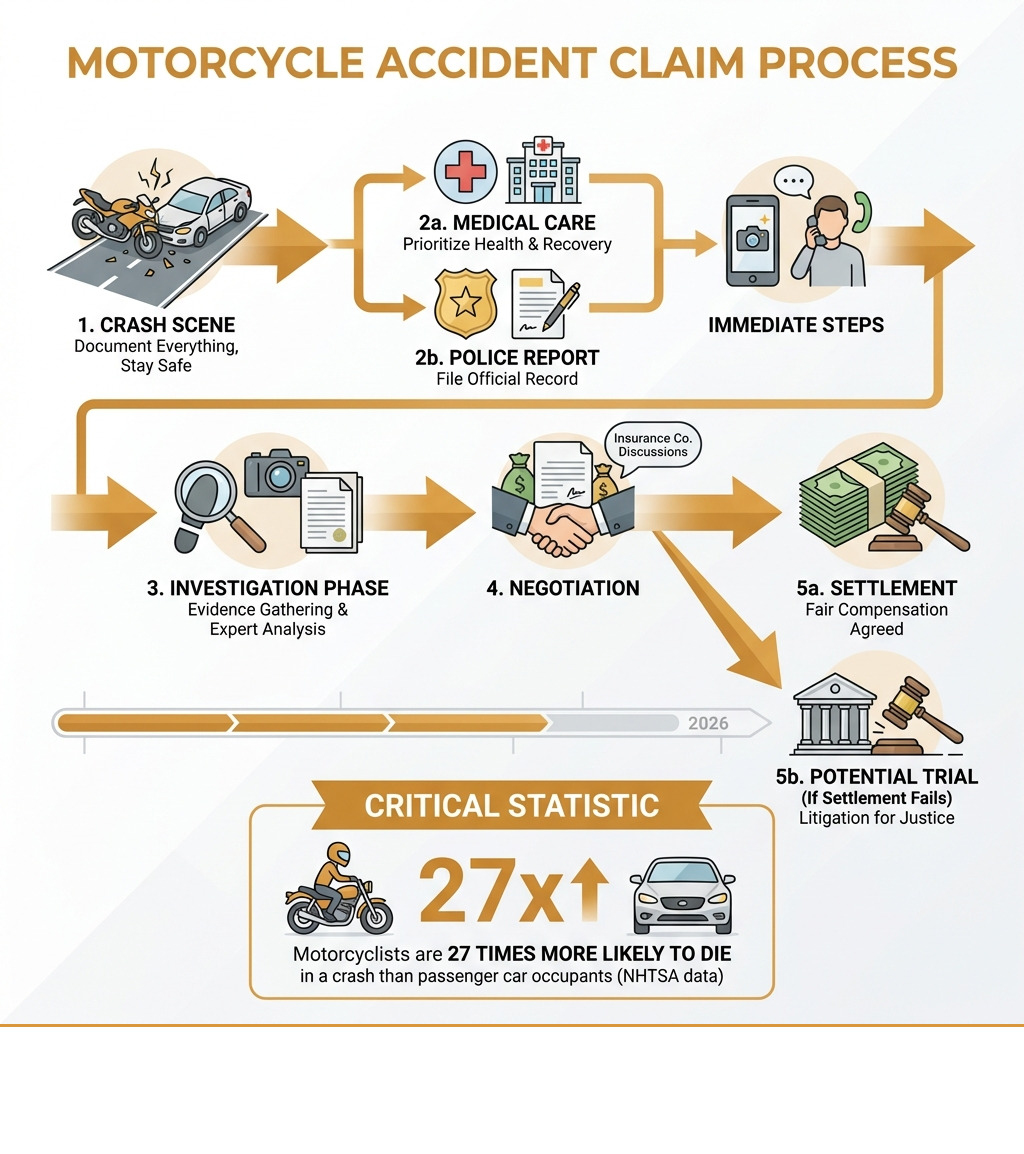
What to Do Immediately After a Motorcycle Accident
The moments following a crash are chaotic, but the actions you take can significantly impact your physical recovery and your legal standing. If you are involved in a collision, your first priorities must be safety, medical care, law enforcement help, and documentation.

First, move to a safe area if possible and call 911. Even if you believe your injuries are minor, an official police report is a vital piece of evidence. This report contains the officer’s initial findings, witness statements, and often a preliminary determination of fault. While waiting for emergency services, if you are physically able, use your phone to capture the scene. Take photos of the vehicle positions, skid marks, road conditions, and any visible injuries.
Gathering witness contact information is equally crucial. Neutral third parties can provide the unbiased testimony needed to counter insurance adjusters who might try to shift blame onto you. For a detailed breakdown of the protocol to follow, review our guide on What to Do After Motorcycle Accident: 10 Steps You Should Take.
The Importance of Medical Documentation
Seeking immediate medical evaluation is critical to making sure you can get better. In a motorcycle accident, the surge of adrenaline can mask severe pain. Many life-altering conditions, such as internal bleeding or concussions and traumatic brain injuries, may not show symptoms for hours or even days.
Signs of a brain injury—such as headaches, blurred vision, dizziness, or confusion—must be taken seriously. Motorcycle Accidents Are More Likely to Result in Serious Injury compared to car crashes, often requiring long-term care that must be documented from day one.
Proving Liability and the Role of Lawyers for Motorcycle Accidents
Proving who is at fault in a Maine motorcycle accident requires more than just a “he-said, she-said” argument. It requires a meticulous investigation into the mechanics of the crash. We look for evidence of distracted driver negligence, such as a driver failing to check their blind spot before a lane change or ignoring a motorcycle’s right-of-way at an intersection.
To win a claim, we must establish four key legal pillars:
- Duty of Care: The other driver had a legal obligation to drive safely.
- Breach of Duty: The driver failed that obligation (e.g., speeding or texting).
- Causation: That failure directly caused the accident.
- Damages: You suffered actual losses, such as medical bills or pain and suffering.
Our team often utilizes accident reconstruction experts who analyze sight distances and vehicle damage to prove how the collision occurred. Navigating these requirements is a hurdle best cleared with professional help. Learn more about How to Navigate a Personal Injury Claim If You’ve Been in a Motorcycle Accident to ensure your rights are protected.
Why You Need Specialized Lawyers for Motorcycle Accidents
You might wonder why a general personal injury lawyer isn’t enough. The truth is that motorcyclists face a specific “biker bias.” Many people, including potential jurors and insurance adjusters, subconsciously view riders as risk-takers. This bias can lead to unfair assumptions that the rider must have been speeding or weaving through traffic.
Specialized lawyers for motorcycle accidents know how to dismantle these stereotypes. We focus on the facts: the car driver who didn’t signal, the speeding delivery driver, or the defective part on the bike itself. We understand the technical aspects of riding and can speak the language of the road to ensure your story is heard accurately. Our experience in Motorcycle Accidents allows us to anticipate the tactics insurance companies use to devalue your claim.
Typical Injuries and the Path to Recovery
Motorcycle injuries are rarely “minor.” Because riders are exposed, even a low-speed “fender bender” for a car can be a life-changing event for a motorcyclist. We frequently see cases involving road rash, which can lead to permanent scarring or infection, and complex bone fractures that require multiple surgeries.
More severe cases involve spinal cord damage or traumatic brain injuries (TBI). These injuries don’t just result in a one-time hospital bill; they often require a lifetime of physical therapy, home modifications, and specialized equipment.
Recovering Damages with Lawyers for Motorcycle Accidents
When we file a claim, we pursue both economic and non-economic damages. Economic damages are quantifiable: medical bills, future surgery costs, and lost wages if you can no longer work. Non-economic damages are intangible but equally important: pain and suffering, emotional distress, and loss of enjoyment of life.
In one notable case, our firm secured $2 Million in Damages for Motorcycle Crash Injuries, highlighting how a thorough legal strategy can account for the full scope of a victim’s losses. We don’t just look at the bills you have now; we look at how this accident will affect your ability to support your family ten years down the line.
Navigating Insurance Tactics and Compensation
Insurance adjusters are not your friends. Their job is to protect their company’s bottom line, which they do by offering “lowball” settlements immediately after an accident. They hope you are stressed and desperate enough to take a quick check and sign away your right to sue.
They may ask for a “recorded statement,” which they will later use to twist your words and imply fault. This is why we tell our clients: do not speak to the insurance company without your lawyer present. We handle all communications, ensuring that your rights are protected.
At Garmey Law, we work on a contingency fee basis. This means you don’t pay us a dime out of pocket. We only get paid if we win your case, taking a percentage of the final settlement or verdict. This allows you to focus on your recovery while we focus on the litigation. Our success in cases like the Former Pole Dancer Wins 2.5 in Damages for Motorcycle Accident Injuries demonstrates our commitment to fighting for every client, regardless of their background or the size of the opponent.
Frequently Asked Questions about Motorcycle Claims
Can I still recover compensation if I wasn’t wearing a helmet?
Yes. In Maine, riders over the age of 18 (with some exceptions for those with learner’s permits) are not legally required to wear a helmet. However, not wearing one can impact your claim through the lens of comparative negligence. If you suffer a head injury, the insurance company will argue that your injuries would have been less severe had you been wearing a helmet. We work to prove that the other driver’s negligence was the primary cause of the accident itself.
Is lane splitting legal, and how does it impact my case?
No, lane splitting—the practice of riding between lanes of slow-moving or stopped traffic—is not legal in Maine. If you were lane-splitting at the time of the crash, it could be used as evidence of negligence on your part. This would likely increase your percentage of fault under Maine’s comparative negligence laws, potentially reducing or barring your recovery.
What is the statute of limitations for filing a claim?
In Maine, the statute of limitations for most personal injury claims is six years from the date of the accident. This is significantly longer than in many other states. However, you should not wait. Evidence disappears, witnesses move, and memories fade. Acting promptly allows your lawyers for motorcycle accidents to build the strongest case possible from the very beginning.
Ready to Hire Lawyers for Motorcycle Accidents?
A motorcycle accident can turn your world upside down in a heartbeat. Between the physical pain of recovery and the mounting financial pressure of medical bills, you shouldn’t have to fight a massive insurance company alone. At Garmey Law, we take pride in representing the “underdogs.”
We understand that you aren’t just a claim number; you are a person whose life has been disrupted by someone else’s negligence. Our contingency fee model ensures that everyone has access to high-quality legal help, regardless of their financial situation. We are ready to take your case as far as it needs to go—even to trial—to get you the justice you deserve.
If you or a loved one has been injured, don’t leave your future to chance. Contact our experienced lawyers for motorcycle accidents today for a free consultation and let us help you get back on the road to recovery.