

Suing for medical malpractice is the legal process of holding a healthcare provider accountable when their failure to meet the accepted standard of care causes you harm. Here is what it involves at a glance:
- Confirm that a duty of care existed between you and the provider
- Show that the provider breached that duty
- Prove that the breach directly caused your injury
- Document the damages you suffered as a result
- File your claim within Maine’s 3-year statute of limitations
- Comply with pre-suit requirements, including a pre-litigation panel hearing
- Work with a medical expert witness to support your case
Medical mistakes happen more often than most people realize. And when they do, the consequences can be life-altering — lost income, long-term disability, and in the worst cases, the loss of a loved one. Yet many victims never pursue a claim, either because they don’t know their rights or because the process feels overwhelming.
Understanding the Legal Grounds for Suing for Medical Malpractice
Before we can step into a courtroom, we have to establish the legal foundation of your claim. In Maine, simply being unhappy with a medical result does not mean you have a claim, and it is not enough to win a lawsuit. We must prove four specific “elements” to show that what happened to you meets the legal definition of malpractice.
First, we look at the duty of care. This is the easiest part to prove; if you were a patient and the doctor agreed to treat you, a duty of care existed. This means the provider had a legal obligation to provide care that meets professional standards.
Second, we must prove a breach of duty. This happens when a provider’s actions (or lack of action) deviate from the “standard of care”—what a reasonably competent professional with similar training would have done in the same situation. It is important to understand the difference between medical malpractice and general negligence; while negligence is a general “oops,” malpractice is a professional failure to adhere to the rules of the craft.
The third and often most difficult element is proximate causation. We have to prove that the doctor’s mistake—and not your underlying illness—actually caused your injury. Finally, we must show compensable harm. You must have suffered actual damages, such as additional medical bills, lost wages, or physical pain.
Common Examples of Medical Errors
Medical errors come in many forms, but they generally fall into a few recognizable categories. At Garmey Law, we frequently see cases involving:
- Misdiagnosis or Delayed Diagnosis: This is one of the most common grounds for suing for medical malpractice. If a doctor fails to recognize symptoms of a heart attack or cancer that a competent doctor would have caught, the delay can be fatal. Diagnostic errors in healthcare often qualify as malpractice because they rob the patient of a chance at recovery.
- Surgical Mistakes: This includes “never events,” such as leaving a sponge inside a patient or operating on the wrong body part. It also covers instances where a surgeon nicked an organ due to poor technique or failed to monitor the patient post-op.
- Medication Errors: Giving the wrong dose, the wrong drug, or failing to check for dangerous drug interactions.
- Anesthesia Errors: These are particularly dangerous. A small mistake in sedation can lead to brain damage or “anesthesia awareness,” where a patient is awake but paralyzed during surgery. For more detail, see our pocket guide to anesthesia medical malpractice.
- Birth Injuries: Negligence during labor and delivery can result in permanent conditions like cerebral palsy or Erb’s palsy.
Proving Your Case: The Role of Expert Witnesses
In Maine, you cannot simply stand in front of a judge and say a doctor messed up. You need a “peer” to say it for you. This is where expert witnesses come in.
An expert witness is typically another doctor in the same specialty as the defendant. If we are suing a cardiologist in Portland, we will likely hire a highly qualified cardiologist to review the records. They testify about the standard of practice and explain to the jury exactly how the defendant failed to meet it.
These experts are the backbone of your case. They provide the credibility needed to overcome the natural “pro-doctor” bias that many jurors hold. Without a strong expert opinion, a medical malpractice case is almost impossible to win.
The Step-by-Step Process of Suing for Medical Malpractice
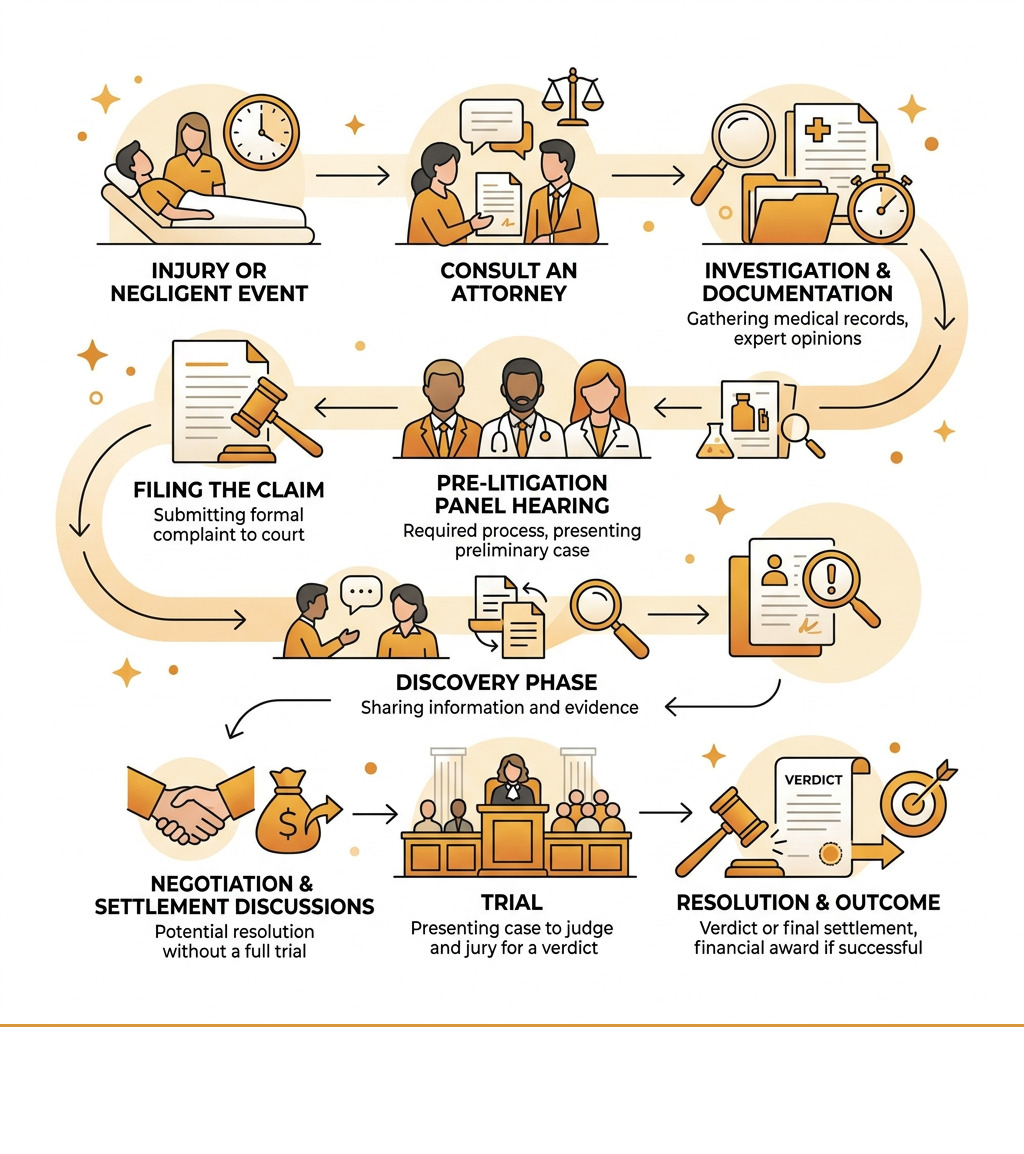
When you decide to move forward, the process begins with an initial consultation. At Garmey Law, we sit down with you to hear your story from start to finish. We want to know every detail, from your first symptoms to the moment you realized something was wrong.
Next comes the evidence-gathering phase. This is an exhaustive process where we collect every page of your medical history. We don’t just look at the records from the “bad” visit; we often look at 10 to 15 years of history to ensure the defense can’t blame your injury on a pre-existing condition. Knowing what to expect when suing is half the battle. We handle the heavy lifting of requesting and reviewing records, so you can focus on your recovery.
Filing the Notice of Claim and Pre-Suit Requirements
Maine has unique “hoops” that you must jump through before your case ever reaches a courtroom. The most critical is the Notice of Claim. This is a formal document that notifies the healthcare provider and the court that you intend to sue.
Once the notice is filed, Maine law requires a pre-litigation screening panel hearing. This is a mini-trial where a panel (usually consisting of a lawyer, a judge, and a doctor) hears the evidence and decides if there is a “reasonable probability” of malpractice. While the panel’s decision isn’t final, it heavily influences whether a case settles or goes to trial.
You must also keep a close eye on the Maine statute of limitations. Generally, you have three years from the date of the negligent act to file your claim. If you miss this deadline, your right to seek justice is gone forever.
Discovery, Mediation, and Settlement Negotiations
If your case passes the panel phase, we enter Discovery. This is the “information exchange” part of the lawsuit. We send interrogatories (written questions) to the doctor and conduct depositions, where we question the medical staff under oath.
During this time, we often engage in Alternative Dispute Resolution, such as mediation. A neutral third party helps both sides try to reach a settlement. Many lawsuits involving poor medical care end in settlements because it provides the victim with guaranteed compensation without the risk and stress of a trial.
Timelines and Costs: What to Expect When Suing for Medical Malpractice
Let’s be honest: suing for medical malpractice is neither fast nor cheap. Because these cases are so complex, they require significant financial investment.
At Garmey Law, we work on a contingency fee basis. This means you pay nothing upfront. We cover all the costs of the experts and the litigation, and we only get paid if we win a settlement or verdict for you. You can learn more about our medical malpractice practice area and how we structure these fees to protect our clients.
Why Cases Take 4 to 7 Years to Resolve
It can be frustrating to hear that your case might take seven years to finish. Why does it take so long?
First, the investigation phase is slow. It takes months to get records and more months for experts to review them. Second, the defense will use every strategy available to delay the process. They hope that by dragging things out, the plaintiff will become desperate and accept a lower settlement.
Finally, court backlogs in Maine can add a year or more to any trial date. Our job at Garmey Law is to push back against these delays and keep your case moving forward as aggressively as possible.
Recovering Damages: Compensation for Your Injuries
When we talk about “damages,” we are talking about the money required to make you “whole” again. While no amount of money can undo a permanent injury, it can provide the security you need to move forward.
Damages are generally split into two types:
- Economic Damages: These are quantifiable losses. They include medical bills, the cost of future surgeries, and lost wages.
- Non-Economic Damages: This covers “pain and suffering,” emotional distress, and loss of enjoyment of life.
Calculating the Value of Suing for Medical Malpractice
How much is your case worth? It depends on the severity of the harm and the impact on your life. For example, a misdiagnosis that leads to paralysis will result in a much higher settlement than a temporary infection, because the “life care plan”—the cost of 24/7 care and equipment for the rest of the victim’s life—is immense.
We work with life care planners and economists to calculate every penny you will need for the next 20, 30, or 50 years. We also consider “loss of consortium,” which compensates your spouse or family for the loss of your companionship and support.
Frequently Asked Questions about Medical Malpractice Lawsuits
How long do I have to file a claim in Maine?
In Maine, the statute of limitations for medical malpractice is generally three years from the date of the act or omission that caused the injury.
There are a few exceptions, such as the “discovery rule” for foreign objects left in the body (where the clock starts when you find the object) or cases involving minors. However, these exceptions are narrow. You should always consult a lawyer the moment you suspect something is wrong to avoid missing your window.
Why might a lawyer decline my malpractice case?
It is a “bitter pill to swallow” when a lawyer says no, but it usually comes down to a cost-benefit analysis. Because medical malpractice cases cost $50,000 to $100,000+ to litigate, the potential recovery must be high enough to cover those costs and still leave the client with a meaningful amount of money.
A lawyer might decline a case if:
- The injury, while real, was not “permanent” or “severe” enough to justify the litigation costs.
- Causation is too difficult to prove (e.g., the patient was already very ill).
- The doctor followed the “standard of care” even though the outcome was bad.
Does a bad medical outcome always mean malpractice?
No. This is a hard truth: bad outcomes happen even with good care. Medicine is an uncertain science. A surgery can fail, or a patient can have a rare reaction to a drug, without the doctor doing anything wrong. Malpractice only exists if the doctor made a mistake that a “reasonably competent” doctor would not have made.
Ready to Explore Your Medical Malpractice Claim?
Suing for medical malpractice is a journey for the “underdog.” You are often going up against massive hospitals and insurance companies with unlimited resources. That is why Garmey Law exists. We provide the aggressive, compassionate advocacy needed to level the playing field.
We represent clients in Portland, Biddeford, Saco, and across Maine who have been silenced by the healthcare system. We believe in accountability, and we aren’t afraid of the long road to get there.
If you believe you have been a victim of medical negligence, don’t wait until the statute of limitations runs out. Contact the medical malpractice lawyers at Garmey Law for a free consultation. We will review your records, consult with experts, and tell you honestly if you have a path to justice. Let us help you hold the system accountable.