

Understanding Your Legal Path After a Motorcycle Crash
A motorcycle crash lawsuit is a legal claim filed by an injured rider to recover compensation for medical bills, lost wages, pain and suffering, and other damages caused by another party’s negligence. If you’ve been hurt in a motorcycle accident, understanding the legal process from the crash scene to final settlement is essential to protecting your rights and securing the financial recovery you need.
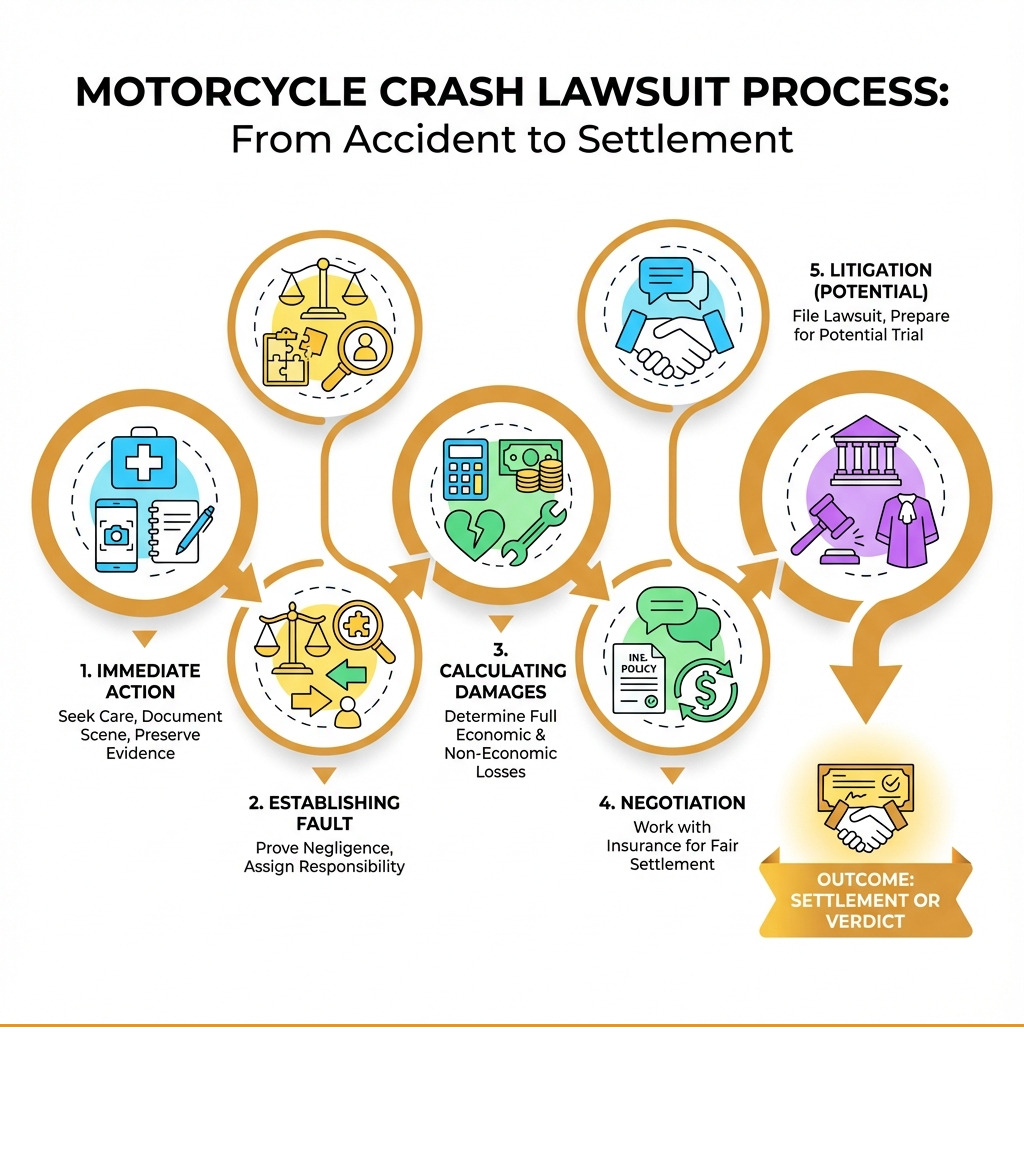
Here’s what the motorcycle crash lawsuit process typically involves:
- Immediate Action – Seek medical care, document the scene, and preserve evidence
- Establishing Fault – Prove the other party’s negligence caused your injuries
- Calculating Damages – Determine the full value of your economic and non-economic losses
- Negotiation – Work with insurance companies to reach a fair settlement
- Litigation – File a lawsuit and go to trial if a fair settlement cannot be reached
The stakes are high. In 2022, 6,218 motorcyclists lost their lives, making up 15% of all traffic fatalities. Survivors often face catastrophic injuries, mounting medical bills, and lost income.
This guide walks you through each stage of a motorcycle crash lawsuit, from the moments after the accident to reaching a settlement or verdict. You’ll learn what evidence to gather, how damages are calculated, what challenges to expect, and why specialized legal representation matters.
What to Do Immediately After a Motorcycle Crash
The moments immediately following a motorcycle accident can be chaotic and frightening. However, the actions you take (or don’t take) during this critical time can significantly impact the success of any future motorcycle crash lawsuit. Our priority is always your safety and well-being, but we also want to ensure your legal rights are protected.
First and foremost, prioritize safety. If you are able, move to a safe location away from traffic. Then, seek immediate medical attention, even if you feel fine. Adrenaline can mask pain, and some serious injuries, like internal bleeding or concussions, may not be immediately apparent. Calling 911 ensures that emergency services respond and a police report is filed, which is crucial documentation for your case.
Once medical attention is secured and the scene is safe, begin to document everything. Use your phone to take photos and videos of the accident scene from multiple angles, including vehicle positions, road conditions, traffic signs, and any visible injuries or property damage. Exchange driver information with all involved parties, collecting names, contact details, insurance information, and vehicle license plate numbers. Don’t forget to collect contact information from any witnesses who may have seen the crash. Their impartial statements can be invaluable.
It’s also vital to preserve evidence. This includes your damaged motorcycle and any gear you were wearing, such as your helmet, jacket, or boots. Do not allow your motorcycle to be repaired before it has been thoroughly inspected by experts. This physical evidence can speak volumes about the crash dynamics and the severity of impact.
Finally, be cautious about what you say. Avoid admitting fault, even if you think you might have contributed to the accident. Your perception of events in the immediate aftermath might be incomplete or inaccurate. Be polite, but limit your discussion of the accident to law enforcement and medical personnel.
For a more detailed checklist of actions, we’ve prepared a comprehensive guide: What to Do After Motorcycle Accident: 10 Steps You Should Take.
Building Your Motorcycle Crash Lawsuit: Establishing Fault
Building a strong motorcycle crash lawsuit hinges on establishing fault. In Maine, proving that another party’s negligence caused your accident and injuries is paramount. This involves a thorough investigation to determine what led to the crash and who was responsible.
Common causes of motorcycle accidents often involve other drivers failing to see or yield to motorcyclists. These include:
- Left-Turn Accidents: A significant percentage of multi-vehicle motorcycle crashes occur when a car turns left in front of an oncoming motorcycle. Drivers often misjudge the motorcycle’s speed or simply fail to see them.
- Unsafe Lane Changes: Drivers may merge or change lanes without checking their blind spots, cutting off a motorcyclist or forcing them off the road.
- Distracted Driving: With the prevalence of cell phones, distracted driving is a growing hazard. A driver looking at their phone instead of the road can easily cause a devastating accident.
- Drunk Driving: Impaired drivers have reduced reaction times and judgment, making them a severe threat to motorcyclists.
- Road Hazards: Potholes, gravel, uneven pavement, or debris can be minor annoyances for cars but can be catastrophic for a motorcyclist. While not always another driver’s fault, the entity responsible for road maintenance could be liable.
There is a persistent problem of inattention and negligence towards motorcyclists on our roads.
Proving negligence is the cornerstone of your case. This requires collecting and analyzing various forms of evidence, such as police reports, which provide an official account of the incident, and witness statements, which offer objective perspectives. We also leverage the expertise of accident reconstruction experts who can analyze physical evidence like skid marks, vehicle damage, and debris to recreate the accident and determine precisely how it occurred. For more on the importance of evidence, see The Importance of Collecting Evidence After a Car Accident.
How Fault is Determined
To succeed in a motorcycle crash lawsuit in Maine, we must prove four key elements of negligence:
- Duty of Care: The at-fault party owed you a legal duty to act reasonably (e.g., following traffic laws, driving safely).
- Breach of Duty: The at-fault party violated that duty (e.g., by speeding, running a red light, or failing to yield).
- Causation: The at-fault party’s breach of duty directly caused your accident and injuries.
- Damages: You suffered actual losses (injuries, medical bills, lost wages) as a result of the accident.
Our team carefully gathers and analyzes all available evidence to connect these dots. This includes reviewing police reports, traffic citations, witness accounts, and even traffic camera or dash-cam footage. We also examine vehicle damage and the accident scene to assess factors like speed, points of impact, and right-of-way.
For example, in a common left-turn accident scenario, we would demonstrate that the car driver had a duty to yield to oncoming traffic, breached that duty by turning prematurely, directly causing the collision, and as a result, you sustained specific injuries and damages.
Understanding Comparative Negligence
Sometimes, fault isn’t entirely black and white. In Maine, we operate under a modified comparative negligence rule. This means that if you are found to be partially at fault for the accident, your total compensation can be reduced because of your fault. However, if your fault is determined to be 50% or greater, you will be barred from recovering any damages.
For instance, if you were found to be 20% at fault for an accident, and your total damages were $100,000, your compensation could be reduced by 20%, leaving you with $80,000, or it could be reduced all the way down to $0, or may not be reduced by the judge or jury at all. This rule underscores the importance of a thorough investigation to accurately assign fault and minimize any potential reduction in your recovery. Insurance companies will often try to shift blame onto the motorcyclist, exploiting common biases against riders. Our role is to protect you from such tactics and ensure your actions are fairly assessed.
Understanding how your actions affect your claim is crucial. We dig into all aspects of the crash to ensure that any assigned fault is accurate and legally justified. You can learn more about how fault is handled when it’s shared in our article, What Happens If Both Drivers Are at Fault in an Accident?.
Calculating Damages: What Is Your Claim Worth?
Once fault is established, the next critical step in a motorcycle crash lawsuit is calculating the full extent of your damages. This is not just about immediate costs; it’s about understanding the long-term impact of your injuries on your life. The severity of your injuries, the at-fault party’s insurance policy limits, and the future impact of your injuries are all major factors influencing the value of your claim.
While it’s tempting to ask for an “average settlement,” the truth is that every case is unique. Catastrophic injury cases can result in significantly higher awards, sometimes reaching millions of dollars. The value of your claim depends on a multitude of factors, and we work diligently to ensure every one is accounted for.
To accurately prove damages, we require comprehensive documentation. Here is a list of documents we typically need:
- Medical records and bills (past, present, and future projections)
- Pay stubs and employment records to prove lost wages
- Tax returns and financial statements for lost earning capacity
- Vehicle repair estimates or total loss documentation
- Receipts for out-of-pocket expenses (medication, travel to appointments, assistive devices)
- Personal journals detailing pain, suffering, and emotional distress
- Witness statements regarding your pre- and post-accident condition
Types of Damages in a Motorcycle Crash Lawsuit
In a motorcycle crash lawsuit, damages generally fall into three categories:
Economic Damages: These are quantifiable financial losses.
- Medical Bills: This includes emergency care, hospital stays, surgeries, rehabilitation, physical therapy, prescription medications, and future medical care. Given the vulnerability of riders, these costs can be substantial.
- Lost Wages: Compensation for income you’ve already lost due to your inability to work.
- Future Earning Capacity: If your injuries prevent you from returning to your previous job or working at the same capacity, we seek compensation for your projected lost income over your lifetime.
- Property Damage: The cost to repair or replace your motorcycle and any damaged gear.
Non-Economic Damages: These are intangible losses that are harder to quantify but significantly impact your quality of life.
- Pain and Suffering: Compensation for the physical pain and emotional distress caused by your injuries. We understand that severe injuries, like those common in motorcycle accidents (road rash, broken bones, spinal cord injuries, traumatic brain injuries), lead to immense suffering. Learn more about how we approach this in Understanding Pain and Suffering Damages.
- Emotional Distress: This can include anxiety, depression, PTSD, and other psychological impacts resulting from the trauma of the accident.
- Loss of Enjoyment of Life: If your injuries prevent you from participating in hobbies, recreational activities, or daily routines you once enjoyed, you can be compensated for this loss.
Punitive Damages: In rare cases, if the at-fault party’s conduct was exceptionally reckless, malicious, or grossly negligent (e.g., extreme drunk driving), a court may award punitive damages. These are not intended to compensate you but to punish the wrongdoer and deter similar behavior in the future.
Compensation in Fatal Motorcycle Accident Cases
When a motorcycle accident tragically results in death, the legal process shifts to a Wrongful Death lawsuit. While no amount of money can ever replace a loved one, these lawsuits aim to provide financial stability for surviving family members. In Maine, families can seek compensation for:
- Funeral and Burial Expenses: The costs associated with the funeral, burial, or cremation.
- Loss of Financial Support: Compensation for the income and financial contributions the deceased would have provided to their family.
- Loss of Companionship, Comfort, and Guidance: These non-economic damages acknowledge the profound emotional void left by the loss of a loved one.
- Medical Expenses Incurred Before Death: Any medical costs related to the accident prior to the individual’s passing.
Our firm has experience handling such sensitive cases. For example, in one wrongful death case, a driver with early-onset dementia turned left into a rider’s path, leading to a $1,850,000 settlement for the family. In another instance, a fast left turn at a neighborhood intersection caused a deadly crash, resulting in multiple parties paying a total of $1,000,000 to settle the case. These examples highlight the significant compensation families can receive when the negligence of others leads to such devastating outcomes. We understand the immense grief involved and work aggressively yet compassionately to secure justice. For more information, please see What You Should Know When Filing a Wrongful Death Lawsuit.
Navigating the Legal Process and Common Problems
The journey through a motorcycle crash lawsuit can be lengthy and complex. After the initial steps of seeking medical attention and gathering evidence, you’ll enter the formal legal process, which typically begins with an initial consultation with our firm. During this meeting, we’ll discuss the details of your accident, assess the potential for a claim, and outline the path forward.
Following the consultation, we start on a thorough case investigation. This involves collecting all necessary documents, interviewing witnesses, consulting with experts (like accident reconstructionists or medical specialists), and building a robust argument for your case. Once we have a clear picture of liability and damages, we typically send a demand letter to the at-fault party’s insurance company, outlining your claim and requesting a specific settlement amount.
One of the most common challenges we face is dealing with insurance company tactics. Insurers are businesses, and their primary goal is to minimize payouts. They may offer lowball settlements early on, hoping you’ll accept before fully understanding the extent of your injuries and long-term costs. They might also try to get you to give a recorded statement, which can later be used against you to undermine your claim. It’s crucial to be cautious and allow us to handle all communications with insurance companies on your behalf.
If the demand letter doesn’t lead to a fair offer, we enter into the negotiation process. This often involves back-and-forth discussions with the insurance adjusters. If negotiations stall, we might pursue mediation, where a neutral third party helps facilitate a settlement.
Should all attempts at settlement fail, we would then proceed with filing a lawsuit. This marks the beginning of the litigation phase, which can involve exchanging information with the other side, depositions (out-of-court sworn testimonies), and potentially a trial. While most cases settle before trial, we are always prepared to take your case to court if it means securing the compensation you deserve. For a broader overview, check out the 7 Stages of Personal Injury Lawsuit Timeline.
The Role of a Specialized Attorney in a Motorcycle Crash Lawsuit
Hiring a specialized attorney for your motorcycle crash lawsuit is not just beneficial; it’s often essential. Motorcyclists, unfortunately, face unique challenges in the legal system, including potential jury bias. Some jurors might award less compensation to motorcyclists than to car drivers due to unfair stereotypes or perceptions of risk. An experienced attorney knows how to challenge this bias by presenting compelling evidence and arguments that focus on the facts of the accident, not preconceived notions about riders.
Our role is to steer the complex legal landscape on your behalf. We understand the nuances of Maine’s traffic laws and personal injury statutes. We carefully calculate the true value of your claim, accounting for both immediate and future expenses, ensuring you don’t accept a settlement that falls short of your needs. Insurance companies often try to minimize payouts, but we have the experience and tenacity to negotiate effectively, protecting your rights and advocating for your best interests.
At Garmey Law, we pride ourselves on being aggressive yet compassionate advocates for “underdogs.” We ensure our clients receive the necessary verdicts and settlements, regardless of the opponent’s size. Having a dedicated legal team means you can focus on your recovery while we handle the legal complexities. For more reasons why legal representation is invaluable, read Is It Worth Hiring a Personal Injury Attorney? 5 Reasons.
Frequently Asked Questions about Motorcycle Accident Lawsuits
How long do I have to file a motorcycle accident lawsuit in Maine?
The statute of limitations in Maine is generally six years for personal injury claims, but there are exceptions. It is crucial to act quickly to preserve evidence and protect your rights. You can learn more about the Statue of Limitations and Why It Is Important to Your Case.
How much does it cost to hire a motorcycle accident lawyer?
Most personal injury lawyers, including those specializing in motorcycle accidents, work on a contingency fee basis. This means you do not pay any attorney fees unless they win your case through a settlement or court verdict. This arrangement allows you to pursue justice without an upfront financial burden.
Should I talk to the other driver’s insurance company?
It is best to avoid giving a recorded statement or accepting any settlement offer from an insurance adjuster without first consulting an attorney. Their goal is often to minimize the payout, and your words can be used against you. An attorney can handle all communications to protect your interests. We recommend directing all inquiries to our office once you’ve retained us.
Taking the Next Step After Your Motorcycle Crash
Navigating a motorcycle crash lawsuit is a complex journey filled with legal, medical, and financial challenges. Understanding your rights, preserving evidence, and proving fault are critical steps toward securing the compensation you deserve. At Garmey Law, we provide aggressive and compassionate representation for injured riders, ensuring you are not just another case number. If you or a loved one has been injured, contact us for a free consultation to discuss your Motorcycle Accident case.